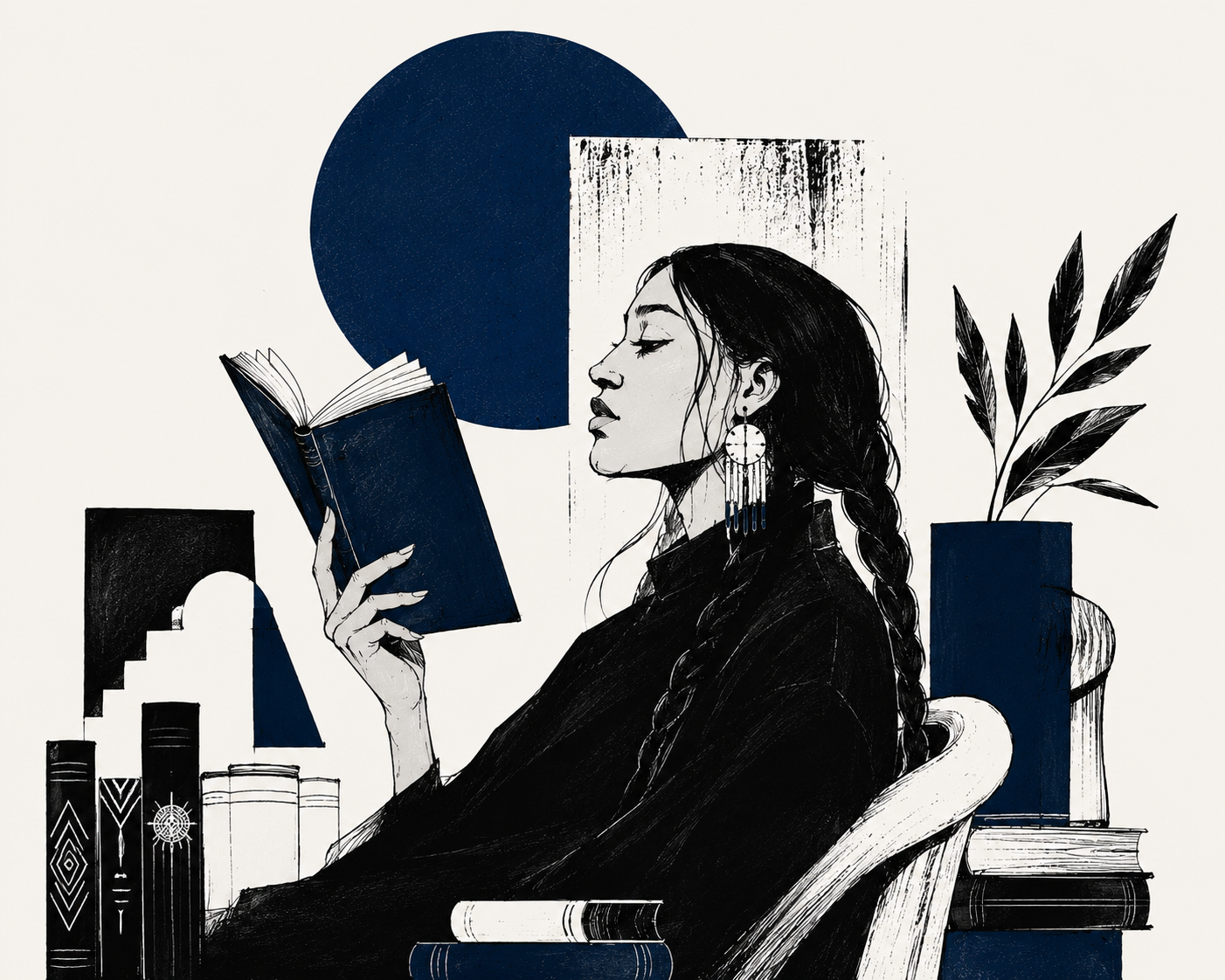
Whenever I find myself indecisive what to read, I run to Google:
”What should I read next?”
“Books to read before turning 21”
“Rory Gilmore reading list”
The only problem is that every website seem to copy the classic books and authors, name a few George Orwell, Elif Şafak, &c. They are good, excellent writers, each have their own voices. However, most of these voices are not Indigenous, the voices that were silenced once.
This list is not a definitive work collection of Indigenous literature. There is no such thing. Indigenous people aren’t monolith—we’re hundreds of nations with different languages, histories, relationships to land and story telling. A Māori writes with the distinctive voice that no Turk could, and vise versa.
This list is simply twenty-five books I admire from different Indigenous authors. 25 books that made me think, made me angry, made me cry, made me want to write and talk about them. Twenty-five voices that deserves more listeners than they have.
Read them in order. Read them out of order. Read one and stop. Read all twenty-five and then find the authors’ other work and read that too. The only wrong way to approach this list is to treat it like a homework, forget that it exists.
Fiction

There There by Tommy Orange
Orange’s debut Novel opens its pages with an essay, aiming to destroy the narrative that Native Americans are a culture of past. The rest of the book is dedicated to prove that these tribes are still there.
Twelve characters. They are not on reservations. They’re in Oakland, California, living regular lives—complicated, messy ones—and converging on the Big Oakland Powwow for reasons they don’t fully understand themselves.
—Nation: Cheyenne and Arapaho Tribes of Oklahoma
—Year: 2018
The Round House by Louise Erdrich
Here’s something you might not know: if a women is raped on a trible land, there is a good chance no one gets prosecuted. This is an injustice all women around the world have to endure.
The Round House shows this injustice through the eyes of thirdteen-year-old Joe Coutts, whose mother is attacked outside their North Dakota home. As the reader, we have the chance to look into Joe’s understanding of the world’s truths.
A mystery novel and a coming-of-age story. It is also an indictment of a legal system designed to fail Native Women.
—Nation: Turtle Mountain Band of Chippewa
—Year: 2012


Five Little Indians by Michelle Good
The residential school system did not end that long ago. The last one closed in 1996.
Five Little Indians is a story that look into the lives of five survivors after they leave the school. Kenny, Lucy, Clara, Howie, and Maisie. Different personalities, traumas, and ways of coping with their pasts.
The structure of the book gives the reader to individually get to know each of the characters.
The best part?
Good is a lawyer who represented residential school survivors. And she based this story on their testimonies. The fiction that is built on facts.
—Nation: Cree
—Year: 2020
The Only Good Indians by Stephen Graham Jones
Not a big fan of horror stories, too many people getting murdered in houses they should not have bought.
However, Jones’s writes a true story that we should consider. The monster is not the people, it is the metaphor. Four Niitsitapi men, haunted by something that happened ten years ago. Something they did, together, that they cannot undo. Something that is coming back for them, one by one.
The story is interested in the past, the monsters we have created and monsters we had to endure. Can you run from them?
—Nation: Niitsitapi
—Year: 2020


Love After the End by Joshua Whitehead
Everyone lives.
It is not a spoiler but the premise. What if the world ends but Two-Spirited and Indigiqueer survived? What is they rebuild their lives without invasion of their culture and oppression they endured?
—Nation: Oji=Cree
—Year: 2020
Moon of the Crusted Snow by Waubgeshig Rice
A post-apocalyptic novel but the apocalypse happens off-screen. The power goes out, the internet dies, supplies stop coming… However, in a remote Anishinaabe community in the North, life goes on.
Rice is interested in what happens when the system fails. Not in a dramatic, zombies-in-the-street way, but in the quite way. the way people keep living because they have to. The way traditional knowledge becomes essential because the modern alternatives are gone.
—Nation: Wasauksing (Anisinaabe)
—Year: 2018


Indian Horse by Richard Wagamese
Saul Indian Horse is a boy when he’s taken from his family and sent to residential school. He survives by escaping into hockey. He is good, really good. He is good enough to leave school, play in the big leagues, to almost forget where he came from.
But you cannot outrun that kind of trauma. The novel follows Saul from childhood through old age, tracking the ways he copes and the ways he falls apart and the ways he puts himself back together.
—Nation: Ojibwe
—Year: 2012
Carpentaria by Alexis Wright
A novel that won the Miles Franklin Award, the biggest Australia’s biggest literary prize.
Wright’s prose is expensive, lyrical, biblical. She draws on Waanyi oral traditions to tell the story of a fictional town on the Gulf of Carpentaria—a town torn between Indigenous residents, white miners, and the forces of nature. The narrative loops and spirals.Times moves differently. characters appear and disappear.
It is not an easy read, but once you find the rhythm, once you stop trying to force it into Western narrative structures, it opens up.
—Nation: Waanyi (Australia)
—Year: 2006


Firekeeper’s Daughter by Angeline Boulley
Reese’s book club pick. Optioned for television by the Obamas’ production company.
Here’s why: it is a thriller about an eighteen-year-old Ojibwe girl who goes undercover to investigate a murder connected to a new drug epidemic in her community. Daunis Fontaine is biracial, unnrolled in her tribe, caught between worlds. She is brilliant, stubborn, and in way over her head.
Boulley weaves in Ojibwe languge and culture without explaining them away. She assumes you can keep up. She trusts her readers.
—Nation: Sault Ste. Marie Tribe of Chippewa
—Year: 2021
The Break by Katherena Vermette
A young woman sees something from her window. An assault, maybe/ She is not sure, she calls the police.
Vermette structures the novel around shifting perspectives—family members, neighbors, police officers, survivor. everyone has a piece of the truth. No one has all of it. The “break” is a place, a space between houses in Winnipeg’s North End where things happen that no one wants to talk about.
This is a novel about intergenerational trauma and the ways violence echoes through families. It’s also about the ways Indigenous women hold each other up, hold each other together, hold on.
—Nation: Métis
—Year: 2016

NON-FICTION

Braiding Sweetgrass by Robin Wall Kimmerer
About plants, mostly. About sweetgrass and strawberries and pecans and algae. About the relationship between humans and the natural world. About what we owe each other and what we owe the land.
Kimmerer is a botanist and an enrolled member of the Citizen Potawatomi Nation. She brings both perspectives to every page. Scientific understanding and traditional knowledge, braided together like the sweetgrass in the title.
—Nation: Citizen Potawatomi Nation
—Year: 2013
The Inconvenient Indian by Thomas King
He is funny, but he is also angry. King’s anger comes wrapped in wit, which makes it easier to swallow and harder to dismiss.
This book is a history of the relationship between Indigenous peoples and settlers in North America. King covers treaties, legislation, pop culture, activism. He traces how policy and law and media have shaped Indigenous lives—and how Indigenous people have shaped themselves in response.
The tone is conversational. You can hear King’s voice on the page, the same voice you’d hear if you saw him speak at a festival or listened to his CBC lectures. It’s accessible without being simplistic, angry without being bitter.
—Nation: Cherokee
—Year: 2012


Hear Berries by Terese Marie Mailhot
Mailhot wrote this memoir from a psychiatric ward. That’s where she was when she started, anyway—hospitalized, diagnosed, medicated. She wrote about growing up on a reservation, about her mother and father, about leaving home and coming back, about love and failure and the ways her mind wouldn’t cooperate.
The prose is raw and fragmented. Mailhot doesn’t explain things for readers who don’t know the context. She writes for herself, first. We’re just listening in.
Some critics called it “lyrical.” Some called it “unflinching.” Both are true but neither captures what it feels like to read. It feels like someone handing you their heart and trusting you not to drop it.
—Nation: Nlaka’pamux
—Year: 2018
Seven Fallen Feathers by Tanya Talaga
Between 2000 and 2011, seven Indigenous high school students died in Thunder Bay, Ontario. They were all sent to the city for school because their home communities didn’t have high schools. They all ended up dead.
Talaga investigated. What she found was racism, neglect, and systemic failure. Police who didn’t investigate. Schools who didn’t care. A city that looked away.
This book is journalism, but it’s also grief. Talaga knew some of these kids’ families. She sat with them, listened to them, told their stories the way they deserved to be told.
—Nation: Anishinaabe
—Year: 2017


A Mind Spread out on the Ground by Alicia Elliott
The title comes from a loose translation of the Mohawk phrase for depression. That’s what this book is about, partly—the depression that comes from living in a world that wants you gone.
Elliott writes essays about poverty, motherhood, mental health, representation. She writes about being Indigenous in a country that pretends reconciliation is possible without justice. She writes about the ways trauma moves through generations, settling in bodies and minds and families.
—Nation: Haudenosaunee (Tuscarora)
—Year: 2019
The Heartbeat of the Wounded Knee by David Treuer
Here’s the narrative you’ve probably heard: 1890, Wounded Knee, the last massacre. Indians defeated, culture destroyed, people vanished into history.
Treuer spends 500 pages proving that narrative wrong.
This is a history of Native America from 1890 to the present. It’s about adaptation and survival, about the ways Indigenous peoples refused to disappear. Treuer covers everything: law, art, politics, activism, sports, literature. He shows how Native communities have changed and grown and fought for their futures.
The book is dense but never dry. Treuer is a novelist as well as a historian, and it shows.
—Nation: Ojibwe
—Year: 2019


Calling for a Blanket Dance by Oscar Hokeah
This is technically fiction, but I’m putting it here because it reads like testimony. The novel follows Ever Geimausaddle through the perspectives of his family—parents, grandparents, aunts, uncles, cousins. Each chapter is told by someone different, revealing another layer of the story.
Ever is Kiowa, Cherokee, and Mexican. His family is spread across Oklahoma and Mexico. The novel tracks how they hold each other up across generations, across borders, across trauma.
It won the PEN America/Hemingway Award. It deserves it.
—Nation: Kiowa and Cherokee
—Year: 2022
Sand Talk by Tyson Yunkaporta
Yunkaporta is an academic who doesn’t write like one. This book is about Indigenous knowledge systems and what they can teach the world. It’s also about why the world probably won’t listen.
He uses “yarns” instead of chapters. He draws diagrams in the sand and photographs them. He argues that Western ways of thinking are destroying the planet and Indigenous ways might offer a way out—but only if we’re willing to do the work.
—Nation: Apalech (Australia)
—Year: 2019

POETRY

Whereas by Layli Long Soldier
In 2009, the U.S. government issued a formal apology to Native peoples. They signed it without ceremony, without tribal leaders present, without public acknowledgment. It was an apology no one heard.
Long Soldier’s collection responds to that document. She takes the language of the resolution and pulls it apart, examining its grammar, its assumptions, its failures. She writes about Lakota linguistics and the ways English can’t capture what she means. She builds poems that are also arguments, that are also elegies, that are also acts of resistance.
This won the National Book Critics Circle Award. Read it and you’ll understand why.
—Nation: Oglala Lakota
—Year: 2017
Postcolonial Love Poem by Natalie Diaz
Diaz won the Pulitzer for this collection. She deserved it.
These poems are about love and desire and the body. They’re about the Colorado River and the desert and the Mojave language she’s working to revitalize. They’re about what it means to be Indigenous and queer in a country that wants you to disappear.
The language is urgent, physical, hungry. Diaz writes like she’s running out of time, like she’s trying to fit everything in before the world ends.
—Nation: Mojave (fort Mohave Tribe)
—Year: 2020


Full-Metal Indigiqueer by Jaye Simpson
Simpson’s poetry is speculative, angry, tender, funny. It refuses to sit still. One poem is about Two-Spirit identity, the next is about video games, the next is about surviving foster care. All of them are connected by a voice that won’t be contained.
The title says it: full-metal. Hard. Unbreakable. Indigiqueer as armor, as weapon, as way of being.
—Nation: Oji-Cree
—Year: 2022
An American Sunrise by Joy Harjo
Harjo was the first Native American to serve as U.S. Poet Laureate. She held the position for three terms. Before that, she was already one of the most important poets in the country.
This collection returns to the land her ancestors were forced to leave during the Trail of Tears. She writes about what was lost and what survived, about grief and resilience, about the Muscogee people then and now.
The poems are accessible without being simple. They’re the work of someone who’s spent a lifetime learning her craft.
—Nation: Muscogee (Creek)
—Year: 2019

ANTHOLOGIES & GRAPHIC NOVELS

This Place: 150 Years Retold
A graphic novel anthology that covers 150 years of Indigenous history in Canada. Ten stories, ten different artists, ten different moments. From the 1800s to the present, from resistance to survival to joy.
The art styles vary wildly. Some stories are realistic, some are abstract, some are almost cartoonish. All of them are grounded in Indigenous perspectives and languages.
This is the kind of book I wish I’d had in high school. The kind that teaches history without pretending it’s neutral.
—Nation: Various Indigenous artists and writers
—Year: 2019
Never Whistle at Night: An Indigenous Dark Fiction Anthology
The title comes from a common belief: don’t whistle at night, or you’ll attract spirits. The stories in this collection explore what happens when you ignore that warning.
Dark fiction, horror, suspense. Indigenous writers doing what they’ve always done—using story to explore the things that scare us. The difference is, these stories are rooted in Indigenous traditions and fears. The monsters are different. The rules are different.
—Nation: Shane Hawk and Theodore C. Van Alst Jr.
—Year: 2023


Beyond the Glittering World by Stacie Shannon Denetsosie, Kinsale Drake, Darcie Little Badger
This one’s brand new. Twenty-two Indigenous women and genderqueer storytellers imagining futures beyond colonial violence. Poems, stories, everything in between.
Little Badger’s contribution involves a museum heist 177 years in the making. Drake’s poems are about Diné identity and belonging. Together, they create something expansive—a vision of what Indigenous literature can be when it’s not constrained by genre or expectation.
—Nation: Navajo, Lipan Apache
—Year: 2025


Leave a Reply